
Financial Flash│By Lee, Chen-Lin ( Daniel Lee )李振麟
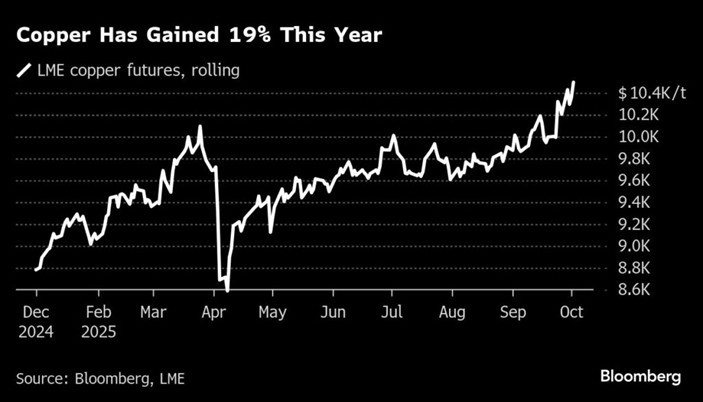
Global copper prices have soared to their highest level of 2025, drawing intense market attention. On the London Metal Exchange (LME), copper futures climbed above US $10,800 per metric ton, the highest since May 2024.
Although the rally has been fueled by supply disruptions and geopolitical factors, analysts warn that without solid end-market consumption, the upswing may not evolve into a “healthy bull market.”
Supply Shocks Ignite the Rally
The immediate trigger came from a major accident at Indonesia’s Grasberg mine, the world’s second-largest copper producer. Operator Freeport-McMoRan declared force majeure, tightening global supply expectations. At the same time, flooding, accidents, and social unrest in key producing nations — including the Congo, Chile, and Peru — have further disrupted global copper logistics.
Earlier, former U.S. President Donald Trump’s decision to impose a 50 percent tariff on imported copper and semi-finished copper products sent shockwaves through the market. Following the announcement, U.S. Comex copper futures surged 13 percent in a single day, the biggest one-day jump since 1989, with prices far exceeding global benchmarks. The price gap between Comex and LME widened to as much as US $2,600 per ton, a record spread.
Industrial Ripple Effects
Market observers caution that copper’s explosive rise could have destructive consequences for consumers, manufacturers, and infrastructure planners alike. From refrigerators and automobiles to AI servers, copper-based components have all seen costs skyrocket. The surge could even distort government power-grid budgets and infrastructure-investment plans.
“Red Metal” Under Dual Pressure — Supply and Green Demand
Known as the red metal of industry, copper is indispensable in electric vehicles, power grids, data centers, and renewable-energy systems. As the global energy transition accelerates, copper’s strategic importance continues to rise.
According to Goldman Sachs, EVs require two to four times more copper than traditional cars. AI data-center expansion and grid upgrades are expected to become the next major growth engines. The bank projects that by 2027, copper prices could reach US $10,750 per ton.
However, developing a new mine takes on average more than 15 years, while ore grades keep declining and environmental reviews grow stricter. As a result, the supply side cannot easily match surging consumption, leaving the market facing a structural shortage in the near term.
Demand Lag Threatens the Rally’s Sustainability
Despite copper’s strong momentum, analysts warn the current rally may be a “bad bull” — driven by supply disruptions rather than robust demand — and thus unlikely to last.
Bloomberg columnist Javier Blas emphasized that a truly sustainable “good bull market” must rest on real consumption growth, particularly from China. Yet, additional tariffs and policy frictions are undermining that demand.
For years, China, the world’s largest copper consumer, has accounted for roughly half of global demand. But concerns over its property-sector recovery and industrial-power usage persist. Without renewed consumption growth, current price levels may prove unsustainable.

A Price Boom Masking Global Economic Risks
While soaring copper prices reflect long-term optimism for the energy transition and infrastructure investment, they also expose the fragility of the global economy. Persistently high prices are prompting manufacturers to switch to cheaper substitutes such as aluminum, a move that could destroy demand and eventually dampen global growth.
Today, the copper market stands at a critical crossroads — whether this surge marks the start of a genuine long-term bull cycle or merely a short-lived burst of supply-chain panic will soon become clear as global economic and policy trends unfold.