
Reported By Lee, Chen-Li(Daniel)李振麟
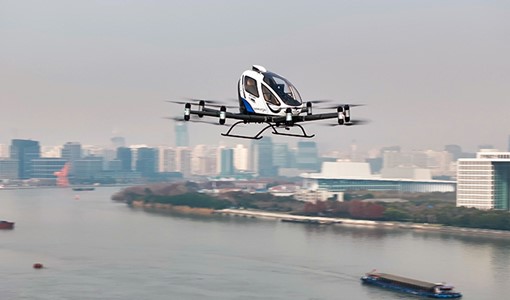
A sleek autonomous oval-shaped aircraft developed by flying taxi manufacturer EHang hovered above the Innovation Riverside Zone on the outskirts of Guangzhou, buzzing like a miniature helicopter as it conducted a demonstration flight. Once seen only in science-fiction films, this aircraft has now become a symbol of the rapid rise of China’s low-altitude economy.
In nearby Shenzhen, drone delivery has already become part of everyday life. Tourists can order beverages through their phones and have them delivered by drone even in light rain. Karolina, a visitor from Poland, ordered bubble tea simply to experience the novelty of a drone “air-drop delivery.” “This is my first time seeing something like this,” she said with a smile. “It’s really amazing to get a drink delivered by a drone.”

Low-Altitude Economy Takes Off, Market to Reach 3.5 Trillion Yuan by 2035
In recent years, major enterprises and local governments have been aggressively promoting the low-altitude industry, igniting a nationwide race in airspace innovation. According to official data from the State Information Center, activities below 1,000 meters generated 506 billion yuan (US$70 billion) in 2023, accounting for about 0.4% of China’s GDP. The industry is expected to surpass 3.5 trillion yuan (US$490 billion) by 2035.
Guangdong Province is the core hub of China’s low-altitude economy. It is home to DJI, the world’s largest commercial drone manufacturer, as well as leading enterprises such as EHang, drone logistics company Phoenix Wings, and XPeng’s flying-car development arm AeroHT (ARIDGE). Jiangsu and Zhejiang follow as major coastal industrial centers.
eVTOL Infrastructure and Policies Advance Together as Urban Air Mobility Takes Shape
To accelerate the implementation of urban air mobility, government agencies are constructing additional flight service stations and takeoff/landing platforms, alongside plans to offer “low-altitude tourism subsidies” to encourage public participation. These efforts also support companies seeking commercial certification for eVTOL (electric vertical takeoff and landing) aircraft.
The Civil Aviation Administration of China has issued Certificates of Airworthiness allowing EHang to operate unmanned eVTOL passenger services. EHang’s aircraft can reach a top speed of 130 km/h with a maximum range of 30 kilometers, primarily targeting sightseeing operations. The company plans to build vertiports in multiple cities and aims to establish several commercial routes within five years. Rooftops of shopping malls, schools, and parks are expected to serve as future air mobility terminals.
Safety Incidents and Battery Constraints Remain Major Challenges
However, achieving widespread adoption of air taxis still faces technical and safety barriers. The biggest challenge is limited battery endurance, said Guo Liming, co-founder of Shenzhen Skyevtol. Current single-seat eVTOLs cost around US$100,000 but can only fly 20–30 minutes before requiring rapid recharging. Changing weather conditions also significantly affect operational safety.
In September, two XPeng AeroHT eVTOLs collided during a rehearsal, with one catching fire upon landing. Although no injuries occurred, the scheduled flight demonstration event was cancelled. XPeng, however, continues pushing forward with mass production and has showcased a six-wheel “ground carrier” concept vehicle equipped with a detachable eVTOL module. The company claims that global pre-orders have already exceeded 7,000 units.
Meanwhile, Germany’s Lilium and Volocopter both filed for bankruptcy due to financial difficulties, with the latter recently acquired by Diamond Aircraft. These developments highlight the significant hurdles that global eVTOL commercialization still faces, including high costs, airspace regulations, and safety requirements.
Airspace Restrictions Drive Companies Toward Overseas Markets
Despite ongoing breakthroughs in drone manufacturing, China’s domestic airspace remains tightly regulated, prompting many companies to seek opportunities abroad. Frank Zhou, Managing Director of GBA Low Altitude Technology, noted that compared with China’s complex airspace system, some overseas markets offer far greater regulatory flexibility—making them promising destinations for Chinese firms looking to expand and commercialize their technologies.
With technological progress, gradual policy easing, and growing consumer demand, China’s low-altitude economy is advancing from conceptual discussion to practical application. From drone delivery to flying taxis, a new form of urban aerial mobility is gradually taking shape—one that may spark a transformative shift in global transportation and industry landscapes over the next decade.